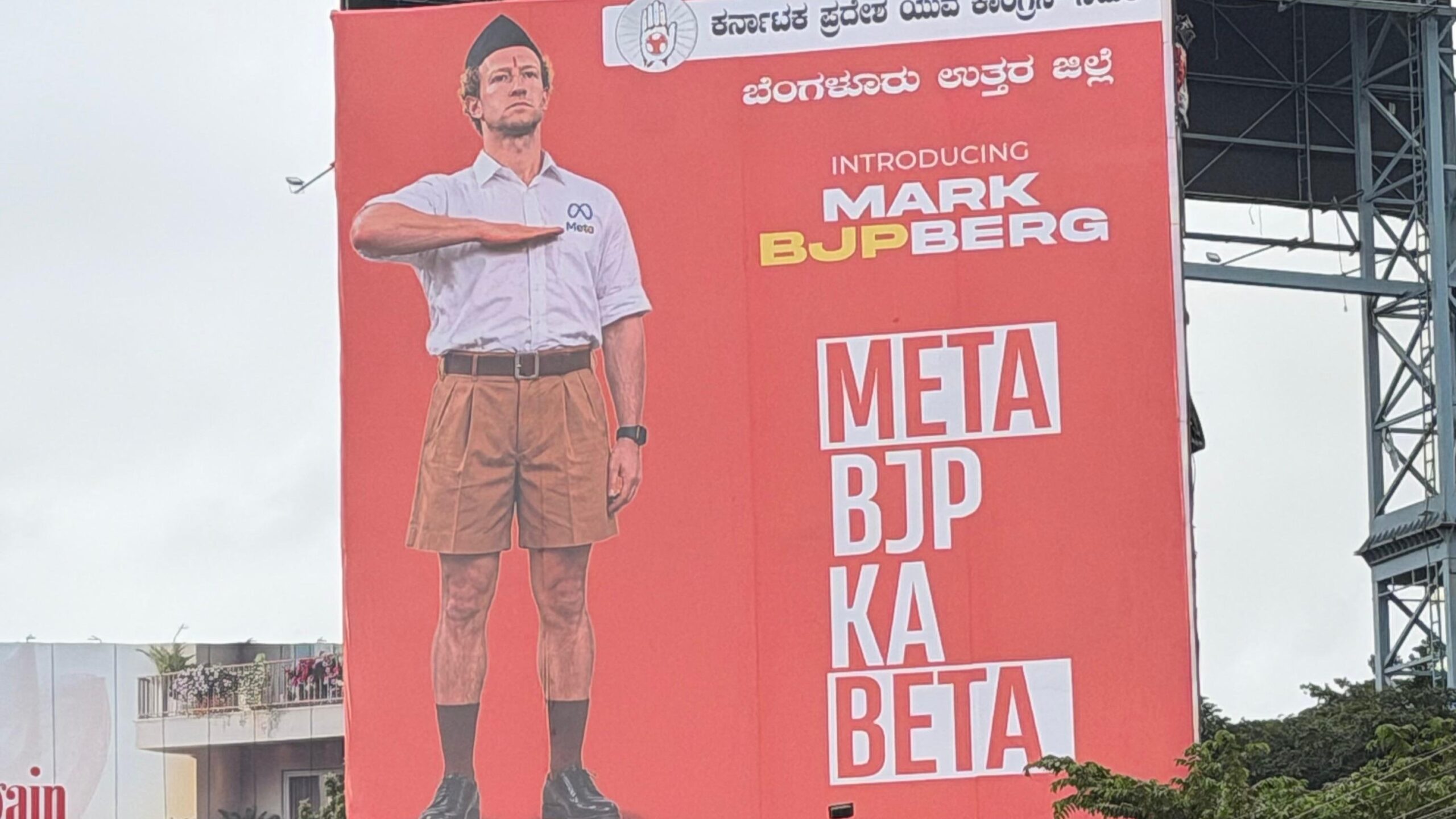
For years, Mark Zuckerberg was synonymous with a grey crewneck T-shirt. He has since moved towards a more unconventional wardrobe, but in India, his latest makeover on street posters has taken on a vastly different meaning.
Posters across India’s technology capital, Bengaluru, depicted Zuckerberg wearing a white shirt, khaki shorts and a black cap.
The outfit resembles the traditional uniform of the Rashtriya Swayamsevak Sangh (RSS), a Hindu nationalist organisation that serves as the ideological parent of the ruling Bharatiya Janata Party (BJP).
These posters, which also showed the Meta founder performing the RSS salute, were put up by the youth wing of India’s main opposition Congress party.
Zuckerberg is referred to as “BJPberg” in the posters and also termed “the son of BJP.”
Congress has accused the social media giant of favouring Prime Minister Narendra Modi’s government and it has been targeting Meta.
Tensions between Meta and Congress have been simmering for more than a week, with youth workers protesting outside the company’s offices in Hyderabad, Mumbai and Gurugram. Demonstrations have also spread to Bengaluru, Delhi and other cities.
The dispute has now reached the courts, with Congress on Wednesday filing a petition against Meta and the Indian government over what it describes as systematic censorship of opposition voices on Facebook and Instagram.
Why is Congress protesting against Meta?
The immediate trigger was the restriction of Instagram accounts belonging to two senior Indian Youth Congress officials, including its national president Uday Bhanu Chib.
The party alleges that Meta has been removing or restricting posts critical of Modi and the BJP while allowing content favourable to the ruling party to remain accessible.
Congress also claims the platform’s automated moderation system has been targeting posts containing the name or photographs of Rahul Gandhi, the leader of the opposition in India’s parliament.
In its petition before the Delhi High Court, the party cited examples of seemingly harmless content being restricted, including birthday greetings, tributes and even a wedding invitation featuring Gandhi.
One example involved a birthday greeting posted on November 8 by a Youth Congress leader. The post showed the leader standing alongside Gandhi but was blocked on the same day.
Congress argues that these restrictions go beyond what the government actually ordered Meta to remove and have created an uneven playing field ahead of several crucial state elections scheduled for early 2027.
The party has asked the court to overturn the automated takedown mandate, restore the restricted posts and require Meta to disclose how its blocking system works.
Why is Meta blocking so much content in India?
The controversy is closely connected to amendments made by the Indian government to its Information Technology rules in February 2026.
Previously, major social media platforms were asked to make efforts to use automated tools to identify duplicate copies of content that had already been taken down following government or court orders.
The February amendments made the requirement mandatory.
Large platforms must now deploy appropriate technical measures, including automated tools, to proactively identify and restrict content that is identical to material previously flagged for removal.
The rules also require platforms to take down unlawful content within three hours of receiving a valid government or court order, compared with the earlier 36-hour deadline.
For Meta, this has created a substantial compliance challenge. Facebook and Instagram have hundreds of millions of users in India, making the country its biggest market by users.
Failing to comply with Indian regulations could expose the company to legal consequences and jeopardise the legal protections available to online intermediaries.
Meta says it is restricting identical copies of previously removed material at scale and within India to comply with the amended rules.
The company has also acknowledged that it is still testing and refining its automated systems because of the unprecedented nature of the requirements.
Its latest transparency disclosures, accessed by Reuters, show that Meta restricted more than 5.4 million items in India during the first half of 2026 under local laws, compared with approximately 70,000 during the whole of 2025.
The sharp increase is largely connected to new rules.
Congress argues that Meta’s actions are at the behest of the ruling party as similar posts uploaded by BJP’s accounts have not been taken down.
However, Meta has said that it remains neutral towards all political parties.
The company’s top executives in India held closed-door talks with the Congress party on Tuesday but did not make any commitments. Congress now has taken Meta to court.
The ruling BJP, meanwhile, has criticised the protests.
National spokesperson Pradeep Bhandari accused Congress workers of vandalising Meta’s Hyderabad office, describing the incident as an example of the party’s approach towards private businesses.
AI disclosure:AI tools assisted with research and drafting of this piece. An Invezz editor reviewed the facts, sources and wording before publication. Any opinions or analysis are Invezz’s, not those of an automated system.
The post Why is Meta facing protests and legal challenges in India? appeared first on Invezz